How Many Miles Is 10,000 Steps? The Real Distance You Walk Every Day

Step-to-Mile Calculator
How Many Miles Do You Walk?
Your fitness tracker counts steps, but not all steps cover the same distance. Calculate your exact walking distance for 10,000 steps using your personal stride length.
Example: With a 2.5-foot stride, 10,000 steps equals 4.73 miles
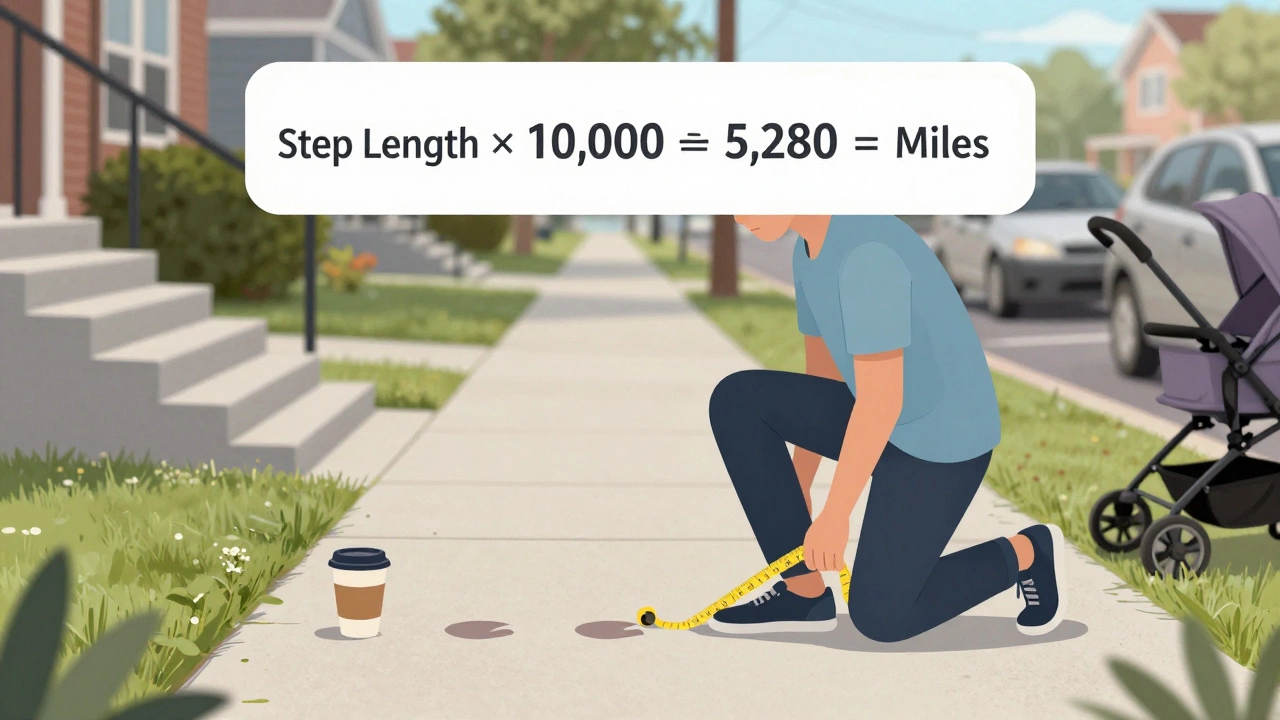
Formula: (2.5 × 10,000) ÷ 5,280 = 4.73 miles
Important: Your stride length affects distance. Shorter people walk fewer miles than taller people for the same number of steps.
When your fitness tracker buzzes to tell you you’ve hit 10,000 steps, it feels like a win. But how far did you actually walk? Is it a mile? Two? Five? The answer isn’t as simple as it sounds.
It’s Not One Size Fits All
Most people assume 10,000 steps equals 5 miles. That number sticks because it’s easy to remember-and it’s roughly true for the average adult. But here’s the truth: your stride length changes everything. If you’re 5’2”, your steps are shorter than someone who’s 6’0”. That means 10,000 steps for you might be 4 miles. For them? More like 5.5 miles.Stride length isn’t just about height. It’s affected by how you walk, your footwear, even your energy level that day. A brisk walk on pavement gives you longer strides than shuffling around the house in socks. A tired walk after work? Shorter steps. A morning power walk? Longer, more efficient strides.
Here’s How to Calculate Your Exact Distance
Start by measuring your personal stride length. It’s easier than you think. Walk 10 normal steps on a flat surface. Measure the distance from the heel of your first step to the heel of your tenth step. Divide that number by 10. That’s your average step length in feet.Then, use this formula:
- Step length (in feet) × 10,000 = total distance in feet
- Divide total feet by 5,280 (feet in a mile)
Example: If your step length is 2.5 feet:
- 2.5 × 10,000 = 25,000 feet
- 25,000 ÷ 5,280 = 4.73 miles
Most fitness trackers estimate this for you, but they often use a default stride length based on your height. If you’re on the shorter or taller side, those estimates can be off by 10-20%. That’s why manually checking your stride once in a while makes a difference.
What Does 10,000 Steps Look Like in Real Life?
Let’s put it into context. If you walk 4.7 miles, that’s:- Walking from your front door to the local supermarket and back, twice
- Completing a loop around your neighborhood park four times
- Strolling along the Bristol Harbourside from the SS Great Britain to the Clifton Suspension Bridge and back
That’s not just exercise-it’s time. About 75-90 minutes of steady walking, depending on your pace. Most people don’t realize how much time it takes to hit 10,000 steps. If you’re mostly sitting at a desk, you might need to carve out two separate walks to get there.
Why 10,000 Steps? Where Did This Number Come From?
The 10,000-step goal didn’t start in a lab. It came from a Japanese pedometer in the 1960s called the “Manpo-kei,” which means “10,000 steps meter.” It was a marketing tool, not a scientific recommendation. But here’s the twist: research since then has shown that 10,000 steps is a solid target for most adults.A 2022 study in The Lancet followed over 90,000 adults and found that health benefits-lower risk of heart disease, improved mood, better sleep-started to peak around 8,000 steps. But people who hit 10,000 steps had the lowest overall mortality rates. That’s not because 10,000 is magical. It’s because it’s a round number that pushes people to move more.
Do You Really Need 10,000 Steps?
Not necessarily. If you’re older, recovering from injury, or have mobility issues, 6,000-7,000 steps a day can still give you major health gains. The goal isn’t to hit a number-it’s to move more than you did yesterday.Here’s what the science says:
- Under 5,000 steps: Sedentary lifestyle. High risk for metabolic issues.
- 5,000-7,500 steps: Low active. Good baseline for beginners.
- 7,500-10,000 steps: Active. Strong health benefits.
- Over 10,000 steps: Highly active. Great for weight management and endurance.
Instead of obsessing over 10,000, focus on consistency. Walk 30 minutes every day, even if it’s just around the block. Over time, your steps will naturally climb.

How to Actually Get to 10,000 Steps
If you’re stuck at 4,000 steps a day, adding 6,000 more feels impossible. But small changes add up:- Take the stairs instead of the elevator-even one floor makes a difference.
- Park farther away from the store entrance. Walk to the next bus stop.
- Have a walking meeting instead of sitting in a conference room.
- Walk while you’re on the phone. You don’t need to be still to talk.
- Set a reminder to walk for 5 minutes every hour. Three of those add up to 15 minutes.
One woman in Bristol I spoke to started by walking to the corner shop for her morning coffee instead of ordering online. She added 1,200 steps just by changing one habit. Within six weeks, she was hitting 9,000 steps daily.
What Your Fitness Tracker Doesn’t Tell You
Your tracker counts steps, but it doesn’t know if you’re walking uphill, pushing a stroller, or pacing while you think. It also doesn’t count the calories you burn accurately. Step count is a proxy for movement-not a perfect measure of effort.That’s why pairing your tracker with heart rate data gives you a better picture. If your heart rate stays low while you’re walking 10,000 steps, you’re not working hard enough to get cardiovascular benefits. If you’re huffing and puffing at 6,000 steps, you’re getting a better workout.
Use step count as a nudge-not a rule. If you hit 8,000 steps but walked briskly up hills, you might’ve done more than someone who hit 10,000 on flat pavement.
Final Thought: It’s About Movement, Not Numbers
10,000 steps is a useful goal, but it’s not the goal. The real goal is to move more than you used to. If you’re walking 6,000 steps today, that’s 2,000 more than last week. That’s progress.Don’t let your tracker make you feel like a failure if you hit 8,500. Celebrate the fact that you moved. Walked. Got up. Got out. That’s what matters.
How many miles is 10,000 steps for a woman?
For an average woman around 5’4", 10,000 steps equals about 4.5 miles. But it varies. Shorter women (5’0") may cover 4 miles, while taller women (5’8"+) can cover up to 5 miles. The best way to know is to measure your own stride length.
How many miles is 10,000 steps for a man?
For an average man around 5’10", 10,000 steps is roughly 5 miles. Taller men (6’0"+) can cover 5.5 miles or more. Men with shorter strides or who walk with a slower pace may cover closer to 4.7 miles. Your height and walking style are the key factors.
Is 10,000 steps a day enough for weight loss?
It can be, but only if it creates a calorie deficit. Walking 10,000 steps burns about 300-500 calories for most people, depending on weight and pace. To lose weight, you also need to watch your diet. Some people lose weight with 10,000 steps and healthy eating. Others need more movement or a bigger calorie cut. It’s not a magic number-it’s part of the puzzle.
Can you get 10,000 steps without leaving the house?
Yes, but it’s hard. You can walk in circles indoors, use a treadmill, or do step aerobics. But most people find it easier to get steps outside. Indoor walking often means shorter, slower steps, and it’s easy to stop. Going outside gives you natural rhythm, fresh air, and motivation to keep going.
Do fitness trackers count steps accurately?
Most trackers are within 5-10% accurate for step counting under normal conditions. But they can overcount if you’re shaking your arms while driving, or undercount if you’re pushing a cart or wearing the tracker too loose. For the most accuracy, wear it snug on your wrist and calibrate it with your actual stride length.