How to Do HIIT Correctly to Maximize Results and Avoid Injury

HIIT Session Calculator
Customize Your HIIT Session
Your HIIT Session Plan
Sample Exercises
Do HIIT only 2-3 times per week to avoid overtraining.
HIIT sounds simple: go hard, rest, repeat. But if you’re doing it wrong, you’re not just wasting time-you’re risking injury, burning out, or hitting a plateau. Millions try HIIT because it promises fat loss and fitness gains in under 30 minutes. But most people mess up the basics. The difference between effective HIIT and just exhausting yourself? Precision.
What HIIT Actually Is (And What It Isn’t)
HIIT stands for High-Intensity Interval Training. It’s not just any fast workout. It’s a specific structure: short bursts of all-out effort followed by recovery periods. The intensity has to be near maximum-like sprinting until your lungs burn. Then you rest enough to catch your breath, but not enough to fully recover. Repeat.
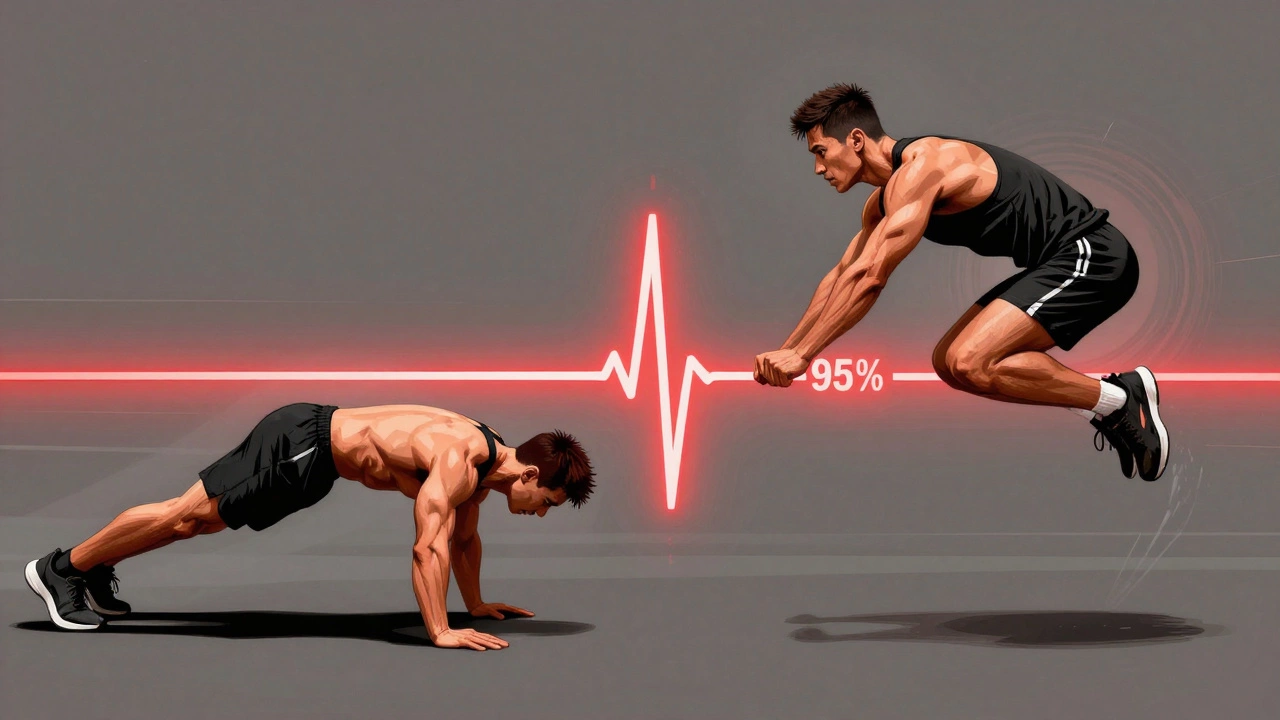
It’s not jogging fast for 10 minutes. It’s not doing 20 burpees with poor form. It’s not a circuit with no rest. Real HIIT pushes your heart rate to 80-95% of your max during work intervals. That’s not easy. And it’s not supposed to be.
Studies show that proper HIIT improves cardiovascular health, burns fat more efficiently than steady-state cardio, and boosts metabolism for hours after the workout. But only if done correctly. One 2023 review in the Journal of Sports Sciences found that people who followed strict HIIT protocols lost 2-3 times more body fat over 12 weeks than those who did “HIIT-style” workouts without proper intensity or recovery.
Step-by-Step: How to Structure a Real HIIT Session
Here’s how to build a HIIT workout that works:
- Warm up for 5-7 minutes. Light cardio like jumping jacks, high knees, or cycling at an easy pace. Your goal is to raise your heart rate and loosen your joints-not exhaust yourself.
- Choose your work-to-rest ratio. Beginners: 20 seconds on, 40 seconds off. Intermediate: 30 seconds on, 30 seconds off. Advanced: 40 seconds on, 20 seconds off. Stick to one ratio per session.
- Pick 4-6 exercises. Use full-body movements: burpees, mountain climbers, kettlebell swings, jump squats, rowing machine sprints, or battle ropes. Avoid isolated moves like bicep curls. You need compound actions that spike your heart rate fast.
- Go all-out during work intervals. This is non-negotiable. If you’re not gasping for air by the end of the 20-40 seconds, you’re not working hard enough. Think: you couldn’t hold this pace for another 10 seconds.
- Recover fully during rest. Walk, stand, or sit. Breathe deep. Don’t just slow down the movement. Your heart rate needs to drop significantly before the next round.
- Repeat the cycle 4-8 times. Most effective sessions last 15-25 minutes total, including warm-up and cool-down.
- Cool down for 3-5 minutes. Light stretching, deep breathing, walking. This helps your body shift out of fight-or-flight mode and reduces soreness.
Common HIIT Mistakes (And How to Fix Them)
Here’s what most people get wrong-and how to fix it:
- Mistake: Skipping warm-ups because “I’m short on time.” Fix: You’re more likely to pull a muscle or tear a tendon cold. Five minutes saves you weeks of recovery.
- Mistake: Doing HIIT every day. Fix: HIIT is brutal on your nervous system. Do it 2-3 times a week max. Fill other days with walking, strength training, or yoga.
- Mistake: Sacrificing form for speed. Fix: If you can’t do a burpee with a flat back and controlled landing, you’re not ready for high intensity. Slow it down. Master the movement first.
- Mistake: Not resting enough between intervals. Fix: If your heart rate doesn’t drop by 20-30 beats per minute during rest, you’re not recovering. Longer rest isn’t failure-it’s strategy.
- Mistake: Thinking HIIT replaces strength training. Fix: HIIT burns calories. Strength builds muscle. Muscle burns more calories at rest. Do both.
HIIT for Beginners: Start Here
If you’ve never done HIIT before, don’t jump into 40-second sprints. Start slow. Here’s a safe, effective beginner routine:
- March in place for 1 minute
- Bodyweight squats (slow and controlled) for 20 seconds
- Rest 40 seconds
- Wall push-ups for 20 seconds
- Rest 40 seconds
- Step-back lunges (hold onto a chair if needed) for 20 seconds
- Rest 40 seconds
- Standing side taps (lift knee to side, tap foot) for 20 seconds
- Rest 40 seconds
- Repeat the whole circuit 3 times
- Walk slowly for 3 minutes to cool down
This takes 20 minutes. You’ll sweat. You’ll feel it. But you won’t get hurt. After 2-3 weeks, swap one exercise for a harder version-like regular push-ups or jumping lunges.
Who Should Avoid HIIT?
HIIT isn’t for everyone-and that’s okay.
Don’t do HIIT if you:
- Have uncontrolled high blood pressure
- Are recovering from a heart condition or recent surgery
- Have joint problems (knees, hips, shoulders) and haven’t built stability yet
- Are pregnant without clearance from your doctor
- Feel dizzy, nauseous, or chest pain during exercise
If you’re unsure, talk to a physical therapist or doctor. There’s no shame in starting with low-impact cardio or strength training first. HIIT will still be there when you’re ready.
How to Track Progress (Without a Scale)
Weight isn’t the best measure of HIIT success. Here’s what to track instead:
- Recovery time: Can you catch your breath faster between intervals?
- Work intensity: Can you do more reps or move faster without breaking form?
- Stamina: Can you complete more rounds in the same time?
- How you feel: More energy during the day? Better sleep? Less afternoon crash?
Take a video of your form every 3 weeks. Compare it. You’ll see improvements in posture, control, and power long before the scale moves.
What to Eat Before and After HIIT
Food matters. HIIT burns glycogen fast. If you’re training fasted, you’ll feel weak and risk muscle loss.
- Before (30-60 minutes prior): A banana with a tablespoon of peanut butter, or a small Greek yogurt with berries. Simple carbs + a little protein.
- After (within 45 minutes): A protein shake, eggs with toast, or chicken with sweet potato. Protein helps repair muscle. Carbs replenish energy stores.
Don’t overeat. You don’t need a big meal. Just enough to support recovery.

How Often Should You Do HIIT?
More isn’t better. Three times a week is the sweet spot for most people. Space them out-like Monday, Wednesday, Friday. Give your body time to recover.
On off days, move. Walk 8,000 steps. Do light yoga. Stretch. Recovery isn’t sitting on the couch. It’s active rest.
If you’re doing HIIT every day and feeling exhausted, sore, or irritable-you’re overtraining. Your body needs time to rebuild. Pushing through burnout doesn’t make you tough. It makes you injured.
Equipment You Need (And What You Don’t)
You don’t need a gym. You don’t need dumbbells. You don’t need a treadmill.
What you need:
- A timer (your phone works)
- A quiet space
- Good shoes
- A mat (optional, for floor exercises)
That’s it. You can do full HIIT workouts in your living room, garage, or even a hotel room. The equipment is simple. The effort? That’s all you.
Can I do HIIT if I’m overweight?
Yes-but modify the movements. Swap jumps for step-backs, burpees for squat-to-presses with light weights, or high knees for marching. Focus on intensity, not impact. HIIT can be done at any body size. The goal is to elevate your heart rate safely, not to look like a fitness influencer.
How long until I see results from HIIT?
Most people notice improved stamina and energy within 2 weeks. Visible fat loss takes 4-8 weeks, depending on diet and sleep. HIIT doesn’t work overnight-but it works faster than steady cardio when done right.
Is HIIT better than running for fat loss?
HIIT burns more calories in less time and keeps your metabolism elevated longer after the workout. Running burns calories during the activity. HIIT burns them before, during, and after. For time-crunched people, HIIT wins. But if you love running, keep doing it. Consistency beats intensity.
Why do I feel sore for days after HIIT?
If you’re new to HIIT or pushed harder than usual, delayed onset muscle soreness (DOMS) is normal. It peaks at 48 hours. But if you’re sore for more than 5 days, you overdid it. Next time, reduce intensity or add more rest. Soreness isn’t a badge of honor-it’s a warning sign.
Can I do HIIT without jumping?
Absolutely. Jumping isn’t required. Use low-impact moves like step-taps, seated knee raises, resistance band rows, or cycling sprints. Many elite athletes do non-jumping HIIT to protect joints. Intensity comes from effort, not airborne movements.
Final Tip: Listen to Your Body
HIIT is powerful-but it’s not a competition. Don’t compare your 20-second sprint to someone else’s. Don’t push through pain. Don’t skip rest because you feel guilty.
The best HIIT workout is the one you can do consistently, safely, and without burnout. It’s not about how hard you go today. It’s about showing up again tomorrow-and the next day, and the next.