What Does the Number 3 Mean in Yoga? Symbolism, Practice & Benefits
The Power of Three: Yoga Symbolism Explorer
Explore how the number 3 shapes your yoga practice through philosophy, breath, and alignment.
Identify Your Current State
According to Samkhya philosophy, everything is composed of three qualities (Gunas). Click a card to see its characteristics and how it affects your practice.
Sattva
Balance, clarity, lightness.
Calm & FocusedRajas
Action, movement, restlessness.
Energy & AnxietyTamas
Inertia, darkness, heaviness.
Rest & LethargyInsight:
Practice the Complete Three-Part Breath
Follow the visual guide to engage the belly, ribs, and chest sequentially during inhalation.
Check Your Standing Pose Alignment
Proper alignment in poses like Tadasana requires engaging three distinct zones. Check off each zone as you feel it engaged.
You’re standing on your mat, maybe holding a Trikonasana or just counting breaths, and you notice something: everything seems to come in threes. Three parts of the body, three types of energy, three stages of practice. It’s not a coincidence. In yoga, the number 3 is one of the most powerful symbols you’ll encounter, but it’s rarely explained clearly to beginners.
If you’ve ever wondered why your teacher says "three breaths" instead of five, or why certain poses are grouped in trios, this guide breaks down exactly what the number 3 means in yoga. We’ll look at the philosophical roots, the physical applications, and how you can use this knowledge to deepen your own practice without getting lost in abstract jargon.
The Core Philosophy: The Three Gunas
To understand the number 3 in yoga, you have to start with Samkhya philosophy, the ancient system that underpins much of yogic theory. According to Samkhya, all matter and mind are made up of three fundamental qualities, known as the Gunas. These aren't just mystical concepts; they describe the actual states of your energy and consciousness.
- Sattva: This represents balance, clarity, and lightness. When Sattva dominates, you feel calm, focused, and aware. Most yoga practices aim to increase Sattva.
- Rajas: This is the energy of action, movement, and restlessness. Rajas drives you to do things, but too much of it leads to anxiety and burnout.
- Tamas: This signifies inertia, darkness, and heaviness. Tamas makes you want to sleep or stay stuck. It’s necessary for rest, but excessive Tamas leads to lethargy.
Every pose, every breath, and every thought shifts the balance between these three forces. When a teacher asks you to hold a pose for three breaths, they are often giving you enough time to observe which Guna is dominant in your body right now. Are you restless (Rajas)? Heavy (Tamas)? Or clear (Sattva)? Recognizing this triad is the first step toward mastering your internal state.
Physical Alignment: The Three Parts of the Body
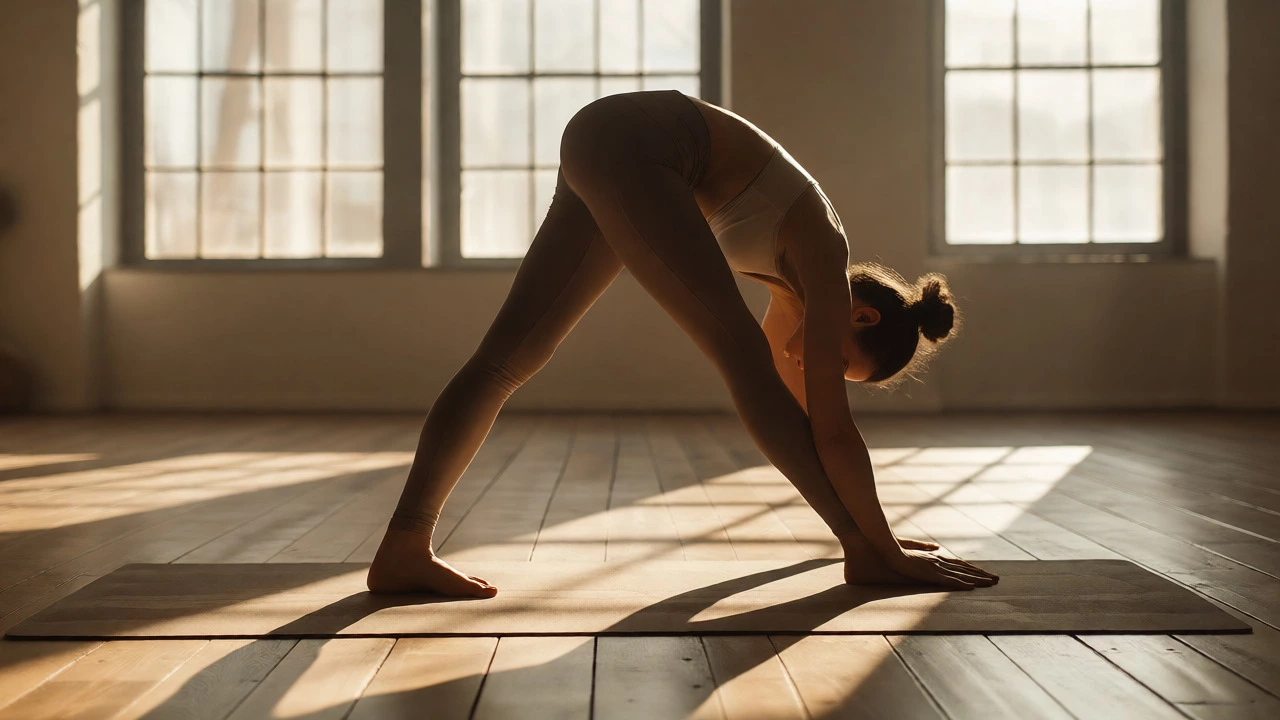
On a practical level, the number 3 appears constantly in how we structure physical alignment. You don’t just "stand up" in yoga; you engage specific structural lines. Think about Tadasana, or Mountain Pose. It looks simple, but proper alignment requires engaging three distinct zones.
| Zone | Action | Purpose |
|---|---|---|
| Feet | Ground through the four corners; lift arches. | Creates stability and foundation. |
| Pelvis | Neutral spine; engage lower abdominal muscles. | Protects the lower back and centers gravity. |
| Crown | Lift the top of the head; relax shoulders. | Creates length and decompresses the spine. |
This triad-foundation, center, and extension-is repeated in almost every asana. In Adho Mukha Svanasana (Downward Dog), you push the floor away (feet/hands), draw the sit bones up (pelvis), and lengthen the spine (crown). If you miss one part of the three, the pose collapses into strain or slackness. Understanding this helps you troubleshoot your own form instantly.
Breathwork: The Three Parts of the Breath
Pranayama, or breath control, also relies heavily on the number 3. While many breathing techniques exist, the concept of the "complete breath" divides respiration into three phases. This isn’t just about filling your lungs; it’s about moving energy through the torso.
- Belly Breathing (Adham): The inhale starts by expanding the diaphragm downward. Your belly moves out. This activates the parasympathetic nervous system, calming you down.
- Rib Cage Breathing (Madhyam): As the belly fills, the ribs expand laterally. This increases oxygen intake and engages the intercostal muscles.
- Upper Chest Breathing (Urdhwam): Finally, the collarbones lift slightly, filling the apex of the lungs. This completes the cycle.
When you exhale, you reverse this order. Practicing this three-part breath ensures you aren’t shallow-breathing, which is common in stress-prone individuals. By consciously engaging all three zones, you maximize oxygen exchange and create a rhythmic pattern that anchors the mind.
Meditation Focus: Trataka and the Third Eye
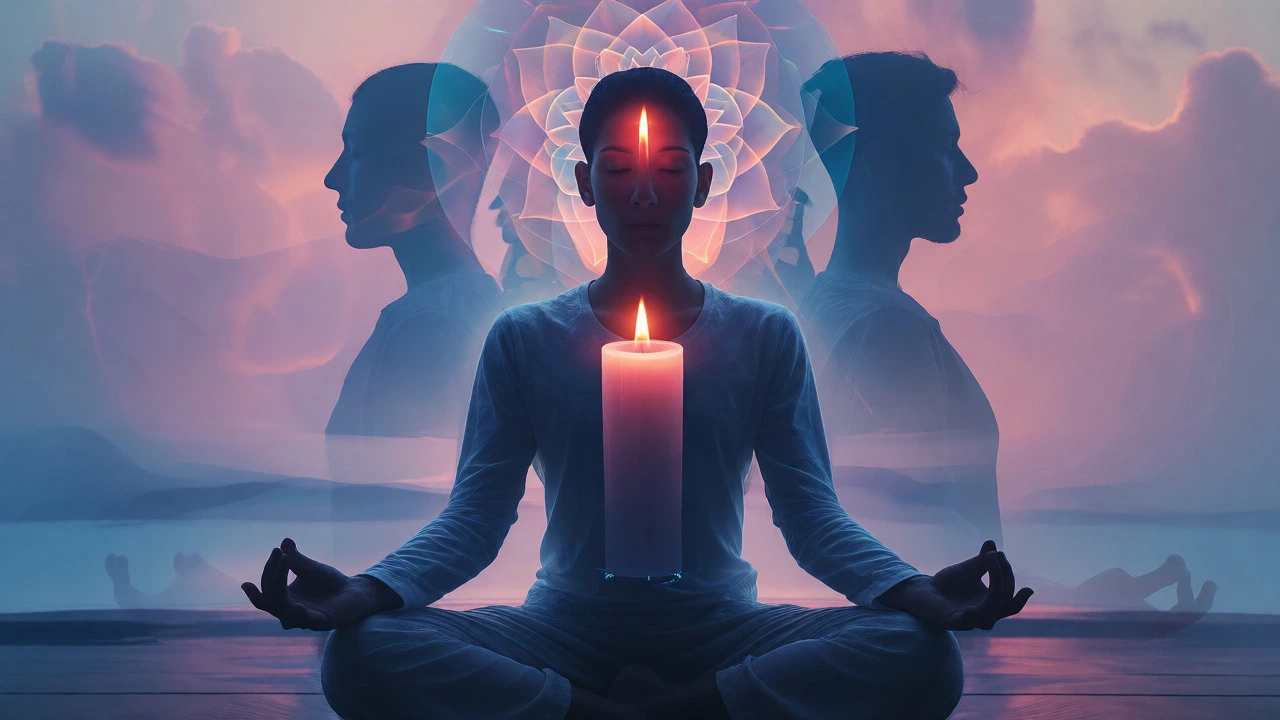
The number 3 is deeply tied to vision and focus in yoga. Trataka is a cleansing technique involving steady gazing at a single point, often a candle flame. But the symbolic heart of this practice is the Ajna Chakra, or the Third Eye.
In yogic anatomy, there are seven main chakras, but the third eye is unique because it sits above the two physical eyes. It represents intuition and inner vision. The number 3 here symbolizes the union of the left and right hemispheres of the brain, or the integration of past and future into the present moment. When you focus on the space between your eyebrows during meditation, you are trying to access this "third" perspective-one that sees beyond duality.
Many practitioners find that focusing on the third eye reduces mental chatter. It’s a tangible way to move from external observation (two eyes) to internal insight (one eye).
Time Cycles: Past, Present, Future
Yoga teaches that suffering often comes from clinging to the past or worrying about the future. The number 3 reminds us that while time exists in these three forms, only the present is actionable. In a yoga class, you might hear cues like "feel the past effort release," "notice the present sensation," and "project intention for the future."
This temporal triad helps frame your practice. You acknowledge where you came from (your injury history, your stress levels), you accept where you are (the tight hamstring, the shaky leg), and you set an intention for where you’re going (greater flexibility, peace of mind). Without this three-fold awareness, practice becomes mechanical. With it, it becomes transformative.
How to Apply the Power of Three in Your Routine
You don’t need to memorize Sanskrit texts to benefit from this. Here is a simple checklist to integrate the number 3 into your next session:
- Warm-up in Threes: Do three rounds of Sun Salutations (Surya Namaskar). This builds heat gradually without overwhelming the body.
- Hold Poses for Three Breaths: Start small. Holding a pose for three deep, complete breaths is enough to signal safety to your nervous system. Gradually increase if needed, but respect the baseline.
- Close with Three Savasana Phases: First, let go of physical tension. Second, let go of mental noise. Third, let go of the ego’s desire to "do" yoga. Just be.
By structuring your practice around these triads, you align with the natural rhythms of the body and mind. It creates a sense of completeness and balance that random stretching simply doesn’t offer.
Why do yoga teachers always count to three?
Counting to three provides a manageable timeframe for beginners to build endurance without triggering the fight-or-flight response. Physiologically, three deep breaths allow the heart rate to stabilize and give the nervous system time to register the new position, reducing the risk of injury.
Is the number 3 sacred in all yoga traditions?
While the significance varies, the triadic structure is prevalent in Hatha, Vinyasa, and Iyengar yoga due to their shared roots in Samkhya philosophy. However, some modern fitness-oriented classes may use arbitrary numbers for pacing rather than spiritual symbolism.
What are the three main paths of yoga?
The Bhagavad Gita outlines three primary paths: Karma Yoga (action/service), Bhakti Yoga (devotion), and Jnana Yoga (knowledge/wisdom). Raja Yoga is sometimes added as a fourth, but the triad of action, devotion, and intellect covers the core approaches to spiritual growth.
Can I use the number 3 for weight loss goals?
Yes. Many yoga-based weight loss programs suggest doing three key poses daily (like Warrior II, Chair Pose, and Plank) to boost metabolism. The consistency of a three-pose routine is easier to maintain than complex sequences, leading to better long-term adherence.
Does holding a pose longer than three breaths change the effect?
Holding longer shifts the focus from strength and stability to flexibility and patience. However, staying too long without proper alignment can lead to hypermobility issues. Three breaths is a safe baseline; extend only when you feel stable and aligned.