What is the 130 Hour Rule for Home Workouts? A Complete Guide
130-Hour Rule Workout Planner
Set Your Schedule
Your Session Plan
This represents the 130-hour annual target based on your weekly consistency.
You’ve probably seen it on social media or heard it in a podcast: the 130-hour rule is a fitness strategy that suggests dedicating 130 hours of exercise within your first year to build lasting health habits and see real physical changes. It sounds specific, almost arbitrary. Why not 100 hours? Why not 200? The number isn’t pulled from thin air. It’s a mathematical sweet spot designed to bridge the gap between starting out and becoming consistent.
If you’re trying to get fit at home, you might be overwhelmed by complex programs. This rule simplifies everything. It doesn’t care if you lift weights, do yoga, or follow a HIIT video. It only cares about one thing: time spent moving. In this guide, we’ll break down exactly how this works, why it matters for home workouts, and how you can hit that target without burning out.
The Math Behind the Magic Number
To understand the 130-hour rule, you have to look at the calendar. There are 52 weeks in a year. If you divide 130 hours by 52 weeks, you get roughly 2.5 hours per week. That’s the core metric. Two and a half hours of activity every single week.
Now, let’s break that down further. If you work out five days a week, that’s just 30 minutes per session. If you prefer longer sessions three times a week, that’s about 50 minutes each time. The flexibility is the point. Most people fail because they aim for perfection-six days a week, an hour a day-and then miss one day, feel guilty, and quit entirely. The 130-hour rule lowers the barrier to entry. It makes failure mathematically harder because the weekly requirement is so manageable.
| Frequency | Duration Per Session | Total Weekly Hours | Best For |
|---|---|---|---|
| 5 days/week | 30 minutes | 2.5 hours | Busy schedules, steady cardio |
| 4 days/week | 37.5 minutes | 2.5 hours | Mixed strength and cardio |
| 3 days/week | 50 minutes | 2.5 hours | Deep focus training, rest days |
| 2 days/week | 75 minutes | 2.5 hours | Long-form activities (hiking, cycling) |
This approach aligns with general health guidelines. Major health organizations often recommend 150 minutes (2.5 hours) of moderate-intensity aerobic activity per week for adults. So, the 130-hour rule isn’t just a viral trend; it’s essentially the annualized version of standard medical advice. It takes the scary idea of "getting fit" and turns it into a simple arithmetic problem.
Why This Works Specifically for Home Workouts
Home workouts face unique challenges. You don’t have a trainer watching you. You don’t have the momentum of a gym crowd. Distractions like laundry, kids, or Netflix are always one click away. The 130-hour rule helps overcome these friction points by focusing on volume over intensity.
When you train at home, consistency beats intensity. Doing a mediocre 30-minute workout at home is infinitely better than planning a perfect 90-minute session that never happens because you got tired driving to the gym. By setting a low bar of 30 minutes a day, you remove the excuse of "not having enough time." Everyone has 30 minutes. The rule forces you to prioritize that block of time.
Additionally, home workouts often rely on bodyweight exercises or minimal equipment like resistance bands or dumbbells. These methods require more time to achieve the same fatigue as heavy machine lifting in a commercial gym. Therefore, accumulating hours is a more accurate measure of progress for home trainers than tracking weight lifted. You need that volume to stimulate muscle growth and cardiovascular improvement without heavy loads.
Building the Habit Loop
The psychological power of the 130-hour rule lies in habit formation. Research in behavioral psychology suggests that it takes repeated exposure to cement a new behavior. By committing to a full year, you’re not just exercising; you’re rewiring your brain to expect movement as part of your daily routine.
In the first month, you might struggle. Your body will ache. Your schedule will clash. But because the goal is only 30 minutes a day, you can usually squeeze it in. After three months, you’ve logged about 30 hours. You start feeling slightly better. You sleep deeper. Your energy stabilizes. By six months (65 hours), exercise is no longer a chore; it’s a non-negotiable part of your identity. You’re not someone who "tries to work out." You’re someone who works out.
This gradual ramp-up prevents burnout. Many people crash after two weeks because they go too hard, too fast. The 130-hour rule encourages a slow, steady pace. It rewards showing up, not killing yourself. If you have a bad day, you still did 20 minutes. That counts. Progress is cumulative.
Tracking Your Progress Without Obsession
To stick to the rule, you need to track your time. However, this shouldn’t become a source of stress. You don’t need expensive apps. A simple notebook or a free timer app works perfectly. The key is honesty. Did you spend 30 minutes moving? Yes or no.
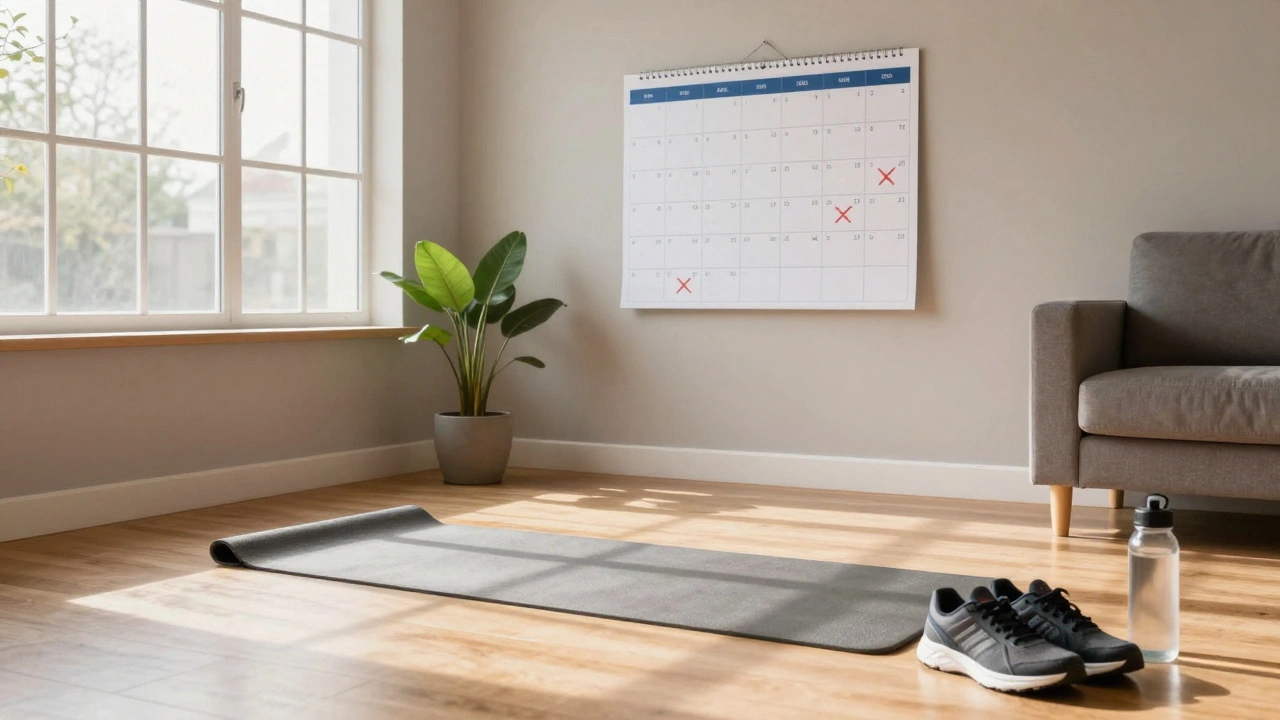
- Use a visible tracker: Put a calendar on your wall. Mark an X for every day you hit your target. The visual chain of Xs motivates you to keep going.
- Batch your logging: Don’t obsess over seconds. Round to the nearest minute. If you planned for 30 but finished in 28, count it. If you went for 45, great, bank the extra credit.
- Weekly reviews: At the end of each week, check if you hit 2.5 hours. If you missed it, adjust the next week. Maybe you need shorter, more frequent sessions.
Avoid the trap of comparing yourself to others. Someone else might log 5 hours a week doing CrossFit. That’s their journey. Your goal is 2.5 hours of sustainable movement. Comparing your Chapter 1 to someone else’s Chapter 10 will only derail your progress.
Common Pitfalls and How to Avoid Them
Even with a simple rule, people stumble. Here are the most common issues I see with home workouters and how to fix them.
The "All or Nothing" Mindset: You miss Monday. You think, "Well, the week is ruined," and skip Tuesday through Sunday. This destroys your yearly total. Instead, practice damage control. Missed Monday? Do a quick 15-minute stretch on Tuesday. Get back on track immediately. One missed day doesn’t erase your progress.
Underestimating Active Rest: Does walking count? Does gardening count? Generally, yes, if it raises your heart rate moderately. The 130-hour rule is flexible. If you’re doing high-intensity interval training (HIIT), 20 minutes might equal 40 minutes of jogging in terms of effort. Use perceived exertion as a guide. If you’re sweating and breathing hard, it counts.
Ignoring Recovery: More isn’t always better. If you push for 4 hours a week when your body needs rest, you’ll get injured. Injury stops all progress. Listen to your body. If you’re exhausted, swap a workout for a gentle yoga flow or a walk. It still logs toward your 130 hours but aids recovery.

Structuring Your Year for Success
To make the 130-hour rule work, you need a plan that evolves. You shouldn’t do the exact same workout for 52 weeks. Boredom is a major killer of consistency. Divide your year into quarters.
- Quarter 1 (Months 1-3): Foundation. Focus on form and consistency. Learn basic movements like squats, push-ups, and lunges. Keep intensity low to moderate. Goal: Build the habit of showing up.
- Quarter 2 (Months 4-6): Strength. Introduce resistance. Use dumbbells or resistance bands. Increase the difficulty of your exercises. Goal: Feel stronger and notice changes in muscle tone.
- Quarter 3 (Months 7-9): Endurance. Add more cardio. Try longer walks, cycling, or dance workouts. Reduce rest periods between sets. Goal: Improve stamina and heart health.
- Quarter 4 (Months 10-12): Integration. Mix it all up. Combine strength and cardio. Try new activities like hiking or swimming. Goal: Enjoyment and sustainability for the next year.
This variety keeps things interesting and ensures you develop a well-rounded physique. It also prevents plateaus where your body adapts to the same stimulus and stops changing.
Realistic Expectations: What Will Change?
If you truly commit to 130 hours over a year, what happens? You won’t look like a bodybuilder overnight. But you will see significant improvements. Most people lose 5-10 pounds of fat if they maintain a slight calorie deficit alongside this activity. You’ll gain lean muscle mass, which boosts your metabolism. Your blood pressure and cholesterol levels often improve. Mental health benefits are profound: reduced anxiety, better sleep, and higher self-esteem.
The biggest change, however, is internal. You prove to yourself that you can set a long-term goal and achieve it. This confidence spills over into other areas of life-work, relationships, personal projects. You learn discipline. You learn patience. You learn that small, consistent actions create massive results over time.
Getting Started Today
You don’t need to wait for Monday. You don’t need new clothes. You just need 30 minutes. Clear a small space in your living room. Find a YouTube video for a beginner home workout. Set a timer. Move for 30 minutes. That’s your first step toward the 130-hour rule. Repeat this five times this week. Then do it again next week. Before you know it, you’ll be halfway through your year, healthier and happier than you ever imagined.
Does the 130-hour rule include warm-ups and cool-downs?
Yes, absolutely. Any time spent moving with intent counts toward your total. Warm-ups prepare your body and prevent injury, while cool-downs aid recovery. Both are essential parts of a complete workout session and should be included in your 30-minute window.
Can I catch up if I miss a month?
It’s possible, but not recommended. Trying to cram 10+ hours into a few weeks increases injury risk and leads to burnout. It’s better to accept the missed time and return to your regular 2.5-hour weekly pace. Consistency over the long term matters more than perfect adherence every single week.
Is 130 hours enough to lose weight?
Exercise alone rarely causes significant weight loss without dietary changes. However, 130 hours of activity creates a substantial calorie deficit over a year. Combined with mindful eating, it can lead to healthy, sustainable weight loss. The primary benefit is body composition improvement-losing fat and gaining muscle-even if the scale doesn’t move dramatically.
Do I need equipment for home workouts under this rule?
No. Bodyweight exercises like push-ups, squats, planks, and jumping jacks are highly effective. While equipment like dumbbells can add variety and progression, they are not required to meet the 130-hour goal. The focus is on time spent moving, not the tools used.
What if I have a busy job or family commitments?
The 130-hour rule is designed for busy people. Breaking it down to 30 minutes a day makes it fit into most schedules. You can do workouts early in the morning, during lunch breaks, or after dinner. The key is finding a consistent slot that works for your lifestyle and protecting that time as a non-negotiable appointment with yourself.