What is the 5-4-3-2-1 Workout Routine? A Complete Guide to Building Fitness

5-4-3-2-1 Workout Generator
Select Your Exercises
Session Timer
Recommended rest between rounds: 2-3 minutes
Have you ever stared at a blank page in your workout journal, wondering how to structure a session that actually works? You want something efficient, effective, and not overly complicated. Enter the 5-4-3-2-1 workout, which is a high-intensity interval training (HIIT) method where you perform five exercises for decreasing repetitions or time intervals. It’s a simple countdown structure that turns a standard gym session into a focused, sweat-inducing challenge.
This isn’t just another trend. The 5-4-3-2-1 routine taps into the principles of circuit training, defined as a form of body conditioning involving a series of stations, each focusing on a different movement pattern. By reducing the volume as you progress, you maintain intensity while managing fatigue. Whether you are in a commercial gym with heavy weights or in your living room with dumbbells, this framework adapts to your environment.
How the 5-4-3-2-1 Structure Works
The core concept is straightforward but deceptive in its simplicity. You select five distinct exercises. Then, you perform them in a specific descending order. There are two main ways to apply this: by repetition count or by time duration.
If you choose the repetition model, you do 5 reps of Exercise A, then 4 reps of Exercise B, down to 1 rep of Exercise E. Once you finish the sequence, you rest briefly and repeat the entire cycle three to four times. This approach is excellent for strength-focused movements like squats or push-ups where counting individual reps makes sense.
Alternatively, the time-based model involves working for 5 minutes on Exercise A, 4 minutes on Exercise B, and so on. This is often used in endurance challenges or steady-state cardio blocks. For most people looking for general fitness, the repetition model is more practical and easier to track without a stopwatch constantly buzzing.
| Feature | Repetition Model | Time-Based Model |
|---|---|---|
| Primary Focus | Muscular Strength & Power | Endurance & Stamina |
| Equipment Needs | Dumbbells, Kettlebells, Bodyweight | Treadmill, Bike, Rowing Machine |
| Session Duration | 20-30 Minutes | 15-20 Minutes (per round) |
| Best For | Hypertrophy & Tone | Cardiovascular Health |
Selecting the Right Exercises
The success of your 5-4-3-2-1 routine depends entirely on your exercise selection. You need a balanced mix that hits all major muscle groups without causing excessive overlap. If you pick five leg exercises, your lower body will fail before your upper body gets a proper stimulus. Aim for a full-body split, which is a training approach that targets every major muscle group in a single session.
A classic setup includes one compound push, one compound pull, one lower-body hinge or squat, one core movement, and one accessory or cardio burst. Here is a reliable template:
- Exercise 1 (Push): Push-ups or Dumbbell Bench Press. These target the chest, shoulders, and triceps.
- Exercise 2 (Pull): Bent-over Rows or Lat Pulldowns. These engage the back and biceps.
- Exercise 3 (Legs): Goblet Squats or Lunges. These build quad and glute strength.
- Exercise 4 (Hinge/Core): Deadlifts or Planks. These stabilize the posterior chain.
- Exercise 5 (Finisher): Burpees or Mountain Climbers. These spike the heart rate.
Notice how no two exercises dominate the same energy system simultaneously. This prevents premature fatigue in any single muscle group. When you drop from 5 reps to 4, you are likely switching from a pushing motion to a pulling motion, allowing your chest to recover slightly while your back takes over.
Why This Routine Is Effective
You might wonder why a simple countdown works better than random sets. The answer lies in progressive overload, which is the gradual increase of stress placed upon the body during exercise training. While traditional linear progression adds weight week over week, the 5-4-3-2-1 routine uses density and intensity within the session.
As the numbers decrease, the perceived effort often increases because your muscles are accumulating fatigue. Doing 1 rep of a heavy deadlift after 4 rounds of previous exercises feels significantly harder than doing 1 rep fresh. This mental and physical challenge boosts metabolic conditioning, defined as training designed to improve the body's ability to produce and use energy efficiently.
Furthermore, the structure eliminates decision fatigue. You don’t have to guess how many reps to do next. The protocol dictates it. This clarity allows you to focus purely on execution and form. In a world where overcomplicated programs lead to burnout, simplicity is a powerful tool for consistency.

Adapting for Different Fitness Levels
One of the biggest misconceptions about HIIT-style routines is that they are only for advanced athletes. The 5-4-3-2-1 method is highly scalable. If you are a beginner, you can reduce the range. Instead of 5-4-3-2-1, try 3-2-1. Or, keep the numbers but reduce the weight significantly. The goal is to complete the set with good form, not to grind out sloppy reps.
For intermediate lifters, the standard 5-4-3-2-1 with moderate weights works well. You can also add a "rest penalty"-if you take too long between exercises, you must restart the round. This keeps the intensity high.
Advanced athletes can turn this into a true test of strength by using heavier loads for the first few exercises and treating the later ones as active recovery. Alternatively, they can perform multiple rounds with minimal rest, turning the session into an anaerobic endurance powerhouse. The key is adjusting the variables-weight, rest, and speed-to match your current capabilities.
Common Mistakes to Avoid
Even simple routines can go wrong if executed poorly. Here are the most frequent pitfalls I see in gyms and home workouts alike.
Ignoring Rest Periods: While the goal is efficiency, resting zero seconds between exercises leads to poor form. Take 30-60 seconds between each exercise transition and 2-3 minutes between full rounds. Your nervous system needs time to reset.
Poor Exercise Order: Don’t put your hardest, most technical movement last. If barbell back squats are your fifth exercise, you will be tired and unstable. Save simpler, less technically demanding moves for the end of the sequence.
Skipping Warm-ups: Jumping straight into 5 reps of heavy lifts is a recipe for injury. Spend 5-10 minutes doing dynamic stretching, light cardio, or empty-bar warm-up sets. Prepare your joints and raise your body temperature before the countdown begins.
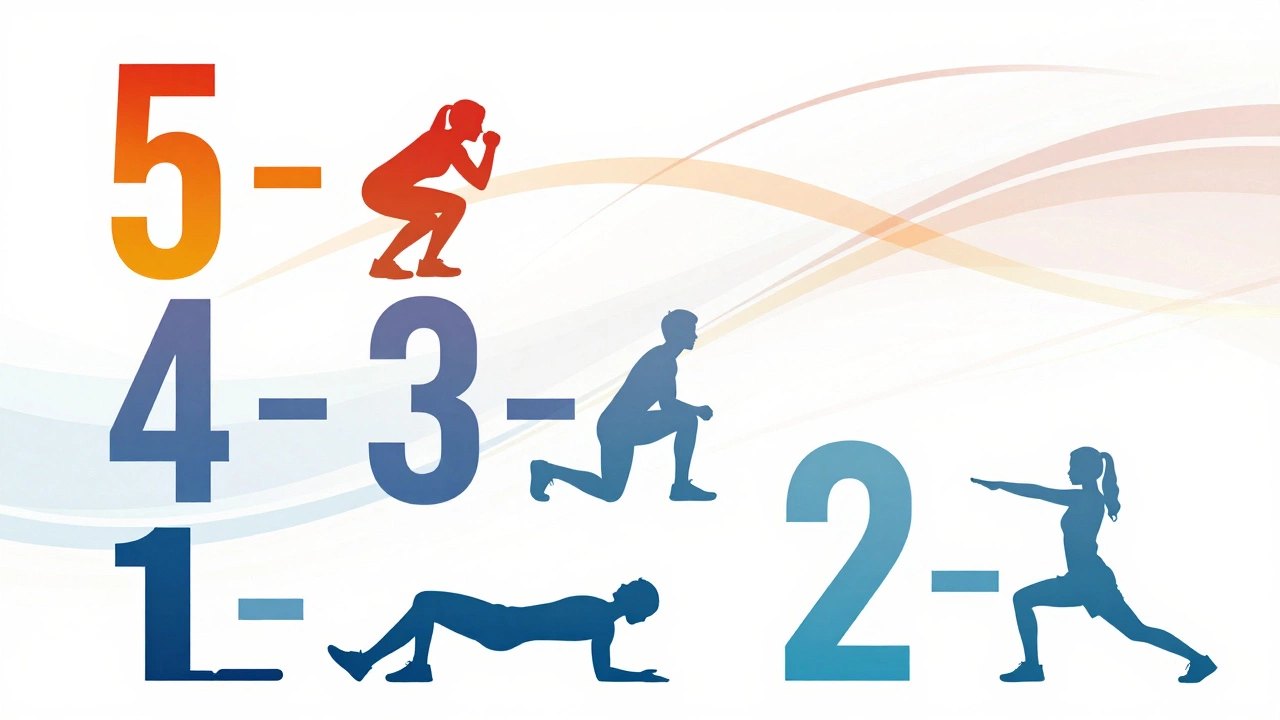
Sample 5-4-3-2-1 Workout Plan
To help you get started, here is a concrete example you can try tomorrow. This plan requires only a pair of dumbbells and a mat.
- 5 Reps: Dumbbell Thrusters (Squat to Press). This combines legs and shoulders for a full-body metabolic hit.
- 4 Reps: Single-Arm Dumbbell Rows. Perform 4 reps per side. Focus on squeezing the shoulder blade.
- 3 Reps: Reverse Lunges. Step back, lower knee, drive up. Do 3 reps per leg.
- 2 Reps: Renegade Rows. From a plank position, row one dumbbell, then the other. Count this as 1 rep. Do 2 total.
- 1 Rep: V-Ups or Hollow Body Hold. Engage the deep core. Hold for 10 seconds if choosing the hold.
Rest 90 seconds. Repeat for 3 to 4 total rounds. Track your weights. Next week, try to use slightly heavier dumbbells or reduce the rest time. This small adjustment drives continuous improvement.
Integrating Into Your Weekly Schedule
You don’t need to do this every day. Because of the high intensity, your central nervous system needs recovery. Aim for 2-3 sessions per week, spaced out by at least one rest day. On off days, focus on mobility work, light walking, or active recovery yoga.
If you follow a traditional split (like push/pull/legs), you can adapt the 5-4-3-2-1 format to those days. For example, on Push Day, all five exercises could involve pressing movements. However, for general health and fat loss, the full-body approach described above is usually superior because it burns more calories per minute and stimulates more muscle tissue overall.
Can I do the 5-4-3-2-1 workout every day?
No, it is not recommended. High-intensity routines place significant stress on your muscles and nervous system. Performing them daily increases the risk of overtraining, injury, and burnout. Allow at least 48 hours of recovery between sessions to let your muscles repair and grow stronger.
Is the 5-4-3-2-1 routine good for weight loss?
Yes, it can be very effective. The combination of strength training and high intensity boosts your metabolism both during and after the workout (known as EPOC or the "afterburn" effect). Additionally, building muscle mass through resistance exercises helps your body burn more calories at rest. Pair this routine with a calorie-controlled diet for best results.
Do I need special equipment for this workout?
Not necessarily. While dumbbells or kettlebells make scaling easier, you can perform a bodyweight-only version. Use push-ups, air squats, lunges, planks, and burpees. As you get stronger, you can add resistance bands or weighted vests to continue challenging your muscles.
How long should I rest between rounds?
Aim for 2 to 3 minutes of rest between full rounds. This allows your heart rate to come down slightly and ensures you have enough energy to maintain proper form in the next set. Shorter rests increase cardiovascular demand, while longer rests favor muscular strength.
Can beginners start with the 5-4-3-2-1 routine?
Absolutely. Beginners should start with lighter weights or bodyweight only and focus on mastering the form of each exercise. You can also reduce the number of rounds to 2 instead of 4. Consistency is more important than intensity when you are just starting out.