What Is the Hardest Fitness Class? The Truth About the Most Demanding Workouts

Fitness Class Difficulty Calculator
Find Your Personal Difficulty Level
Answer these questions to see which fitness class would be hardest for you based on your fitness level, experience, and personal circumstances.
How It Works
This calculator uses your personal factors to determine which fitness class would be hardest for you. Based on your fitness level, experience, and current circumstances, it identifies the class type that would challenge you the most.
Remember: Hardness is highly individual. What's difficult for one person might be easy for another.
Your Personal Difficulty Results
Based on your inputs, this class would be the most challenging for you due to your current fitness level and experience.
Ask ten people what the hardest fitness class is, and you’ll get ten different answers. Some will say CrossFit. Others will swear by Insanity. A few might even name a local bootcamp that leaves them vomiting on the mat. But here’s the truth: there’s no single answer-because hardest isn’t about the workout. It’s about what your body and mind can handle right now.
Why ‘Hardest’ Depends on You
Hardness isn’t measured in calories burned or reps completed. It’s measured in how much you want to quit. That’s why a 30-minute HIIT session can feel harder to one person than a two-hour spin class to another. Your fitness level, past injuries, mental toughness, and even your sleep the night before all change the equation.
Take Sarah, a 38-year-old office worker from Bristol. She’s done yoga for years. When she tried her first CrossFit class, she couldn’t do a single pull-up. The WOD-Workout of the Day-was 15 thrusters and 10 box jumps. She made it through, but her arms shook for hours. To her, that was the hardest thing she’d ever done. Meanwhile, her friend Mark, a former rugby player, did the same workout like it was warm-up. He called it ‘light’.
So when people say ‘CrossFit is the hardest,’ they’re really saying: ‘This is the hardest thing I’ve tried.’
CrossFit: The Poster Child for Hard
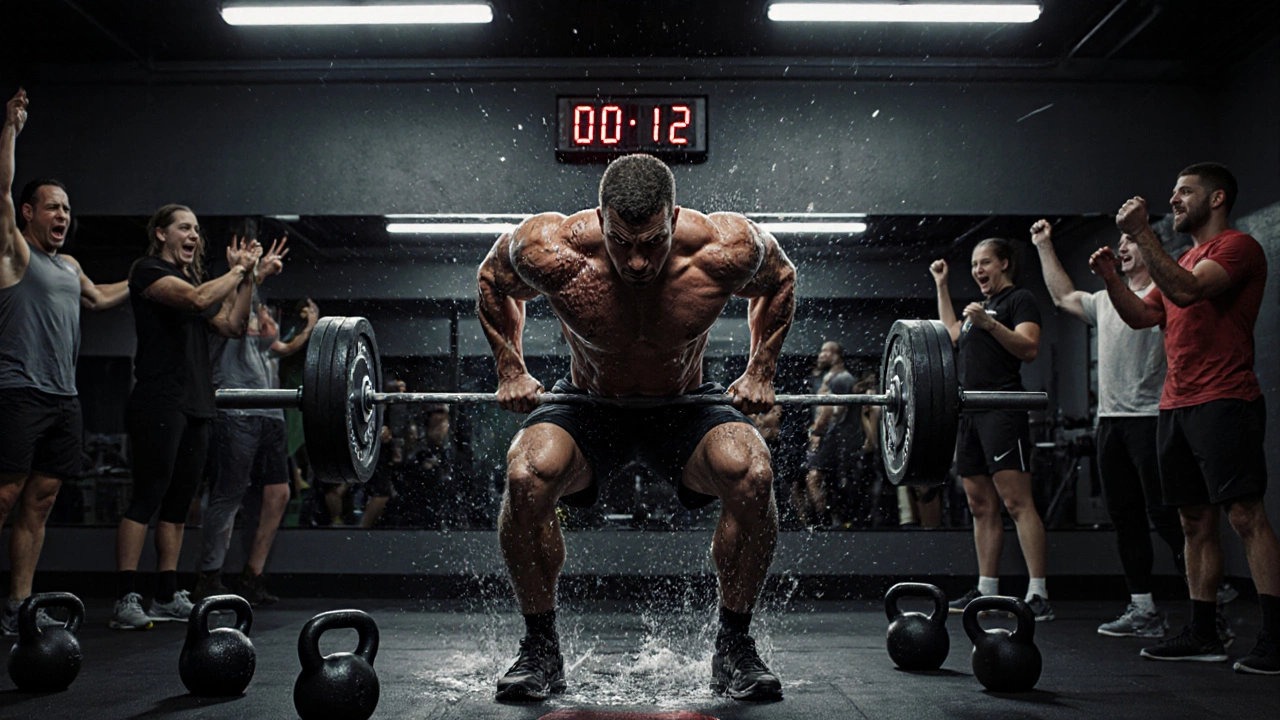
CrossFit is often called the hardest fitness class-and for good reason. It’s designed to push you past your comfort zone, every single time. A typical class includes three parts: a warm-up, a skill or strength segment, then a high-intensity WOD.
WODs are unpredictable. One day you’re doing 21-15-9 reps of deadlifts, burpees, and kettlebell swings. The next, you’re sprinting 400 meters, then doing 50 wall balls, then 30 rope climbs. No two days are the same. That’s part of the draw-and the nightmare.
Studies from the Journal of Strength and Conditioning Research show CrossFit participants burn between 13-18 calories per minute during a WOD. That’s comparable to running a 6-minute mile. But unlike running, you’re also lifting weights, climbing, and moving in all directions. Your heart rate stays elevated, your muscles burn, and your brain screams at you to stop.
And then there’s the culture. The cheering. The timers. The coach yelling, ‘One more!’ while you’re gasping on the floor. It’s not just physical. It’s psychological. You’re not just working out-you’re being tested.
Insanity: When the Floor Becomes Your Enemy
If CrossFit is about strength and variety, Insanity is about endurance and relentless motion. Created by Shaun T, this 60-day program is all high-intensity interval training (HIIT) with zero rest. You’re jumping, punching, twisting, and exploding for 40 to 60 minutes straight.
There are no weights. No equipment. Just your body and a DVD (or app). The moves look simple-jumping jacks, mountain climbers, plyo lunges-but done at max speed, with no breaks, for 10 minutes straight? That’s when your legs turn to jelly.
People who’ve done Insanity describe it as ‘being chased by a monster.’ One participant in a 2024 survey of 2,000 former Insanity users said: ‘I thought I was in shape. Then I did Max Interval Circuit. I cried. I didn’t cry from pain-I cried because I couldn’t believe my body failed me.’
It’s brutal because it doesn’t let you hide. No barbell to grip. No partner to lean on. Just you, your breath, and the clock.
Bootcamps: The Military-Style Grind
Outdoor bootcamps-especially in the UK-have exploded in popularity. Think muddy sprints, tire flips, sled pushes, and burpees in the rain. These classes are often led by ex-military or ex-police trainers who don’t care if you’re sweating, shivering, or crying.
A typical 60-minute bootcamp might include: 10 rounds of 30-second sprints, 20 push-ups, 15 box jumps, 10 kettlebell swings, and a 400-meter carry with a sandbag. Then you do it all again. And again. And again.
What makes bootcamps hard isn’t just the exercises. It’s the environment. You’re outside. In the cold. In the dark. On uneven ground. In Bristol, winter bootcamps are legendary. Rain, wind, and puddles become part of the workout. You don’t just get fit-you get tough.
One study from the University of Exeter found that outdoor HIIT sessions increase perceived exertion by 22% compared to indoor ones. The elements don’t just make it harder-they make it feel worse.
HIIT: The Sneaky Killer
HIIT classes are everywhere now. Gyms, studios, even community centers. They promise results in 20 minutes. And they deliver-but at a cost.
Most HIIT classes alternate 30 seconds of all-out effort with 15 seconds of rest. Sounds manageable, right? Until you’re doing 10 rounds of sprinting, kettlebell swings, and jump squats. Your lungs burn. Your legs scream. Your heart feels like it’s trying to escape your chest.
What makes HIIT sneaky is that it doesn’t look hard. No heavy weights. No long duration. But the intensity? It’s extreme. A 2023 study in the British Journal of Sports Medicine found that people working at 90% of their max heart rate during HIIT reported higher perceived exertion than those doing steady-state cardio for twice as long.
And here’s the catch: if you’re new to fitness, HIIT can feel like a punishment. If you’re experienced, it’s a tool. That’s why the same class can be the hardest thing ever-or just another Tuesday.
Spartan Race Training: The Ultimate Test
If you think a fitness class is hard, wait until you try training for a Spartan Race. These aren’t just workouts-they’re survival simulations. Obstacle courses with 20+ challenges: wall climbs, mud crawls, spear throws, barbed wire underfires, and carrying 40-pound sandbags over 5K.
Spartan-specific training classes focus on functional strength, grip endurance, and mental grit. You’ll do farmer’s carries with logs, rope climbs with fatigued arms, and burpees with weighted vests. Sessions last 90 minutes and leave you with blistered hands, bruised shoulders, and a new respect for your own body.
Over 600,000 people completed a Spartan Race in 2024. Nearly 40% of them said their training class was harder than the race itself. Why? Because the race has a finish line. The training doesn’t. You keep going until you can’t.
What Makes a Class ‘Hardest’? The Real Factors
So what actually makes one class harder than another? It’s not just the moves. It’s the combination of:
- Intensity-how close you’re working to your max effort
- Duration-how long you have to keep going
- Complexity-how many new skills you’re learning at once
- Recovery time-how little rest you get between sets
- Environment-heat, cold, mud, altitude, noise
- Psychological pressure-coaching, timers, group energy
Some classes are hard because they’re long. Others are hard because they’re unpredictable. A few are hard because they force you to face your weaknesses-like your fear of hanging upside down on a rope.
Is the Hardest Class Right for You?
Just because a class is hard doesn’t mean it’s right for you. If you’re recovering from an injury, new to exercise, or just need to reduce stress, a brutal bootcamp might do more harm than good.
Hard workouts aren’t a badge of honor. They’re a tool. And like any tool, they’re only useful if they fit the job.
Ask yourself: Why are you looking for the hardest class?
- Are you trying to break through a plateau?
- Do you need to build mental toughness?
- Are you chasing a goal-like a Spartan Race or a 5K run?
If your answer is ‘I want to suffer,’ then go for it. But if you’re looking for results, consistency beats intensity every time.
What to Do Instead of Chasing the Hardest
Instead of asking ‘What’s the hardest class?’ ask: ‘What’s the most sustainable class for me?’
Try this: Pick one class that challenges you, but doesn’t break you. Do it three times a week. Focus on form. Build strength. Get stronger. Then, after six weeks, try something harder.
That’s how real progress happens-not in one brutal class, but in a hundred consistent ones.
Final Thought: Hard Isn’t the Goal
The hardest fitness class isn’t the one that leaves you on the floor. It’s the one you keep coming back to-even when you’re tired, sore, or scared.
Hardness is temporary. Discipline is permanent.
Is CrossFit really the hardest fitness class?
CrossFit is often considered the hardest because it combines heavy lifting, high-intensity cardio, and complex movements-all in one session. But whether it’s the hardest depends on your fitness level. Someone new to exercise might find a bootcamp harder. Someone with strength training experience might find Insanity tougher. Hardness is personal.
Can HIIT be harder than CrossFit?
Yes. HIIT can feel harder because it’s all about max effort with minimal rest. A 20-minute HIIT class with no weights and no breaks can push your heart rate and lungs harder than a longer CrossFit WOD with rest periods. The lack of variety and the constant intensity make it mentally exhausting.
Why do I feel worse after a bootcamp than a gym workout?
Outdoor bootcamps add environmental stress-cold, wind, rain, uneven terrain-that your body has to manage on top of the physical effort. This increases perceived exertion. Studies show outdoor training feels 20% harder than indoor workouts, even when the exercises are the same.
Is it safe to do the hardest fitness classes every day?
No. High-intensity classes like CrossFit, Insanity, or bootcamps put major stress on your muscles, joints, and central nervous system. Doing them daily increases injury risk and can lead to burnout. Experts recommend no more than 3-4 high-intensity sessions per week, with rest or low-intensity activity on other days.
What’s a good first class if I’m new to fitness?
Start with a beginner-friendly HIIT or strength-based class that offers modifications. Look for coaches who explain form, encourage scaling, and don’t pressure you to go all-out. Your goal isn’t to be the hardest worker-it’s to build consistency and confidence.
Do I need to be in shape before trying a hard fitness class?
No. Most reputable studios offer scaled versions of every movement. You don’t need to do a full pull-up-you can use a band. You don’t need to sprint-you can jog. The class adapts to you, not the other way around. The only requirement is willingness to try.