What Is the Magic Number in Yoga? The Surprising Truth Behind Daily Practice

There’s a quiet myth floating through yoga studios and Instagram feeds: if you do yoga every day for 40 days, something changes. Not just your flexibility, not just your posture-but your whole relationship with yourself. People whisper about it in quiet corners after class. Some swear by it. Others call it superstition. But if you’ve ever tried to build a habit and failed after a week, you’ve probably wondered: is there a magic number in yoga?
Where Did the 40-Day Rule Come From?
The idea isn’t new. It shows up in ancient yogic texts, especially in Kundalini traditions, where 40 days is seen as the minimum time needed to break a habit or establish a new one. It’s not random. It’s based on observation. When you do the same practice-breath, movement, meditation-every day for six weeks, your nervous system starts to rewire. Your brain stops treating it as a chore. It becomes part of your rhythm.
Modern neuroscience backs this up. A 2009 study from University College London tracked people trying to form new habits. The average time to reach automaticity? 66 days. But the fastest group? Those who did it daily, without skipping. The 40-day window is the sweet spot where effort begins to shift into ease. It’s not a guarantee. But it’s the first real sign that change is sticking.
Why 40 Days? Not 7, Not 21, Not 100
You’ve heard the 21-day myth. It’s catchy. But it’s wrong. That number came from a 1960s plastic surgeon’s observation about how long it took patients to adjust after amputations. It had nothing to do with habit formation. And 7 days? That’s just a week. You can fake consistency for seven days. You can’t fake it for 40.
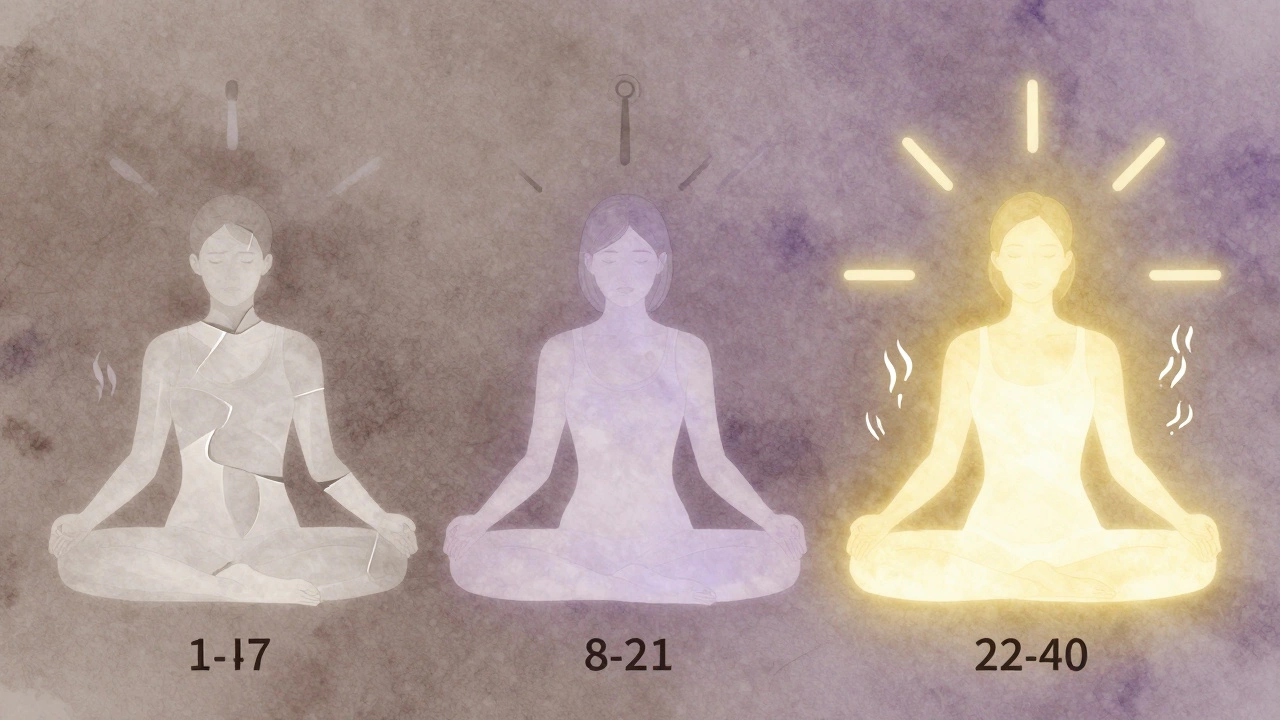
Here’s what happens at each stage:
- Days 1-7: You’re excited. You post pictures. You feel great after class. But if you miss one day, you feel guilty. You think, ‘I ruined it.’
- Days 8-21: The novelty fades. Your legs ache. You skip a morning because you’re tired. You start questioning if it’s worth it.
- Days 22-40: This is the turning point. You don’t think about whether to practice. You just do it. It’s not about discipline anymore. It’s about identity. You’re not ‘someone who does yoga.’ You’re someone who moves with breath.
- Day 41 and beyond: You don’t need motivation. You need less. You notice things you never did before-how your shoulders relax before you even unroll the mat, how your breath slows before you sit down.
The magic isn’t in the pose. It’s in the repetition.
What Does a 40-Day Yoga Practice Actually Look Like?
You don’t need to do two hours of advanced asanas. You don’t need to master headstands. You don’t even need to do yoga every single day-though daily helps.
Here’s what works for real people:
- 15 minutes of sun salutations, three times a week, with 10 minutes of seated breathing on the other days.
- Just 5 minutes of mindful breathing before bed-no poses, no music, no app. Just you and your breath.
- Walking through a few standing poses while brushing your teeth. Yes, really.
One woman I know, a nurse working double shifts, did downward dog for five minutes after her last patient left. She didn’t do a full routine. She didn’t have time. But she did it every day for 40 days. She said the biggest change wasn’t flexibility-it was that she stopped snapping at her kids. She had space between stimulus and reaction. That’s the magic.
The practice doesn’t have to be perfect. It just has to be consistent.
What Changes When You Hit 40 Days?
People report the same things, over and over:
- Better sleep: Not because you’re tired from exercise, but because your nervous system calms down. Cortisol drops. Melatonin rises.
- Less anxiety: Not because yoga ‘cures’ anxiety, but because you learn to sit with discomfort without running from it.
- More patience: You notice you wait in line differently. You don’t check your phone. You breathe.
- Stronger body awareness: You catch tension in your jaw before it becomes a headache. You feel your hips tighten before you even sit down at your desk.
These aren’t mystical outcomes. They’re biological. Yoga trains your parasympathetic nervous system-the part that says, ‘You’re safe.’ Most of us live in fight-or-flight mode. Yoga flips the switch.
One 2021 study in the Journal of Clinical Psychology found that participants who practiced yoga for 40 days showed a 27% reduction in perceived stress levels-without changing anything else in their lives. No therapy. No medication. Just movement and breath.
What If You Skip a Day?
Here’s the truth: you will skip a day. Or two. Or three.
That doesn’t break the magic. It just resets the clock.
Think of it like planting seeds. You water them every day for 39 days. On day 40, you forget. The seed doesn’t die. It just waits. When you return on day 41, you don’t start over. You keep watering.
What matters isn’t perfection. It’s return. The 40-day rule isn’t about flawless execution. It’s about showing up, even when you don’t feel like it. That’s the real practice.

Is 40 Days Enough?
It’s enough to change your relationship with yoga. But it’s not the finish line.
After 40 days, you might realize you want more. Maybe you want to hold poses longer. Maybe you want to try meditation. Maybe you want to understand the philosophy behind the poses. That’s fine. But now you’ve built the foundation. You’re not starting from scratch anymore.
Some people keep going for 100 days. Others for 1,000. One man I read about did yoga every day for 12 years. He didn’t become a teacher. He didn’t open a studio. He just kept showing up. He said, ‘It’s not about becoming someone else. It’s about remembering who you already are.’
That’s the quiet power of the magic number. It’s not about transformation. It’s about return. Return to your breath. Return to your body. Return to yourself.
How to Start Your 40-Day Challenge
Here’s how to make it real:
- Choose one simple routine. Sun salutations. Five standing poses. Seated breathing. Pick one. Don’t overcomplicate it.
- Set a daily alarm. Not for ‘yoga time.’ For ‘breath time.’
- Write down how you feel each day. Just one sentence. ‘Felt calmer.’ ‘Shoulders less tight.’ ‘Didn’t snap at my coworker.’
- Don’t aim for perfection. Aim for return.
- On day 40, don’t stop. Just change it. Add a minute. Try a new pose. Or do nothing at all. Just sit. That’s still yoga.
The magic isn’t in the number. It’s in the commitment. And the commitment? That’s yours to make.
Is the magic number in yoga really 40 days?
Yes, 40 days is the most commonly cited threshold in yogic traditions for establishing a new habit. While science says habit formation takes about 66 days on average, 40 days of consistent daily practice is enough to shift your nervous system, reduce stress, and make yoga feel natural-not forced. It’s not a rule, but a proven starting point for lasting change.
Do I have to do yoga every single day for 40 days?
Daily practice helps, but it’s not required. Missing one or two days won’t break the streak. What matters is returning. If you skip a day, just start again the next. Consistency over time beats perfection. Even 10 minutes, three times a week, can create real change if you stick with it for 40 days.
What if I don’t feel any different after 40 days?
You might not feel dramatic changes right away. Yoga doesn’t work like a quick fix. Look for subtle shifts: better sleep, less tension in your jaw, deeper breaths during stress, more patience in traffic. These are the real signs of progress. If you still don’t notice anything, try tracking your mood daily for a week. Often, the changes are there-you just weren’t looking for them.
Can I do yoga for only 5 minutes a day?
Absolutely. Five minutes of mindful breathing, a few sun salutations, or even just stretching while you wait for your coffee counts. The length doesn’t matter as much as the consistency. A short daily practice builds awareness over time. Many people who stick with 5-minute routines report deeper changes than those who do hour-long sessions once a week.
Is yoga better than other workouts for mental health?
Yoga isn’t necessarily better than other workouts-it’s different. Unlike running or weightlifting, yoga combines movement with breath awareness and mindfulness. This unique mix directly calms the nervous system. Studies show yoga reduces cortisol and increases GABA, a calming brain chemical. If your goal is stress reduction and emotional balance, yoga has a strong edge over purely physical workouts.
Next Steps: What Comes After 40 Days?
When you hit day 40, you’re not done. You’re just getting started.
Now you know you can show up. Now you know what it feels like to move with your breath instead of against it. The next step is to ask: What do I want this practice to do for me now?
Maybe you want to explore meditation. Maybe you want to deepen your stretches. Maybe you want to understand the philosophy behind the poses. Maybe you just want to keep doing five minutes a day-quietly, steadily, without needing to prove anything.
There’s no right answer. The magic wasn’t in the number. It was in the act of choosing yourself, every day, even when no one was watching.