How Many Minutes of HIIT a Day to Lose Weight? The Safe & Effective Guide

HIIT Weight Loss Calculator
You’ve heard the hype. High-Intensity Interval Training (HIIT) promises rapid fat loss in half the time of traditional cardio. But here is the catch: doing too much, too soon, can actually stall your progress and wreck your recovery. So, how many minutes of HIIT do you really need each day to see results without burning out?
The short answer? You probably shouldn’t be doing it every single day. For most people aiming to lose weight, 15 to 30 minutes of HIIT, performed three to four times a week, is the sweet spot. Doing more than that often leads to diminishing returns because your body simply doesn’t have enough time to repair itself.
Why Daily HIIT Is Usually a Bad Idea
It feels counterintuitive. If exercise burns calories, shouldn’t exercising every day burn more calories? In theory, yes. In practice, HIIT is brutally demanding on your central nervous system (CNS). Unlike a leisurely jog, where your body stays in a steady state, HIIT pushes you to near-maximum effort. This creates significant micro-tears in muscle fibers and spikes stress hormones like cortisol.
If you train at maximum intensity seven days a week, you risk entering a state of overtraining. Symptoms include persistent fatigue, poor sleep, joint pain, and ironically, weight gain due to water retention from elevated cortisol levels. Your body needs rest days to rebuild muscle tissue and lower inflammation. Without that downtime, your metabolism can actually slow down as a protective mechanism.
Think of HIIT like sprinting. You wouldn’t expect an athlete to sprint at full speed for an hour straight, right? It’s physically impossible to maintain true high intensity for long periods. If you find yourself doing 60-minute HIIT sessions daily, you’re likely not doing HIIT anymore-you’re just doing moderate cardio with intervals, which is fine, but it won’t give you the same metabolic boost.
The Sweet Spot: Duration and Frequency
To maximize fat loss while preserving muscle mass, structure your week around quality, not quantity. Here is a practical breakdown based on fitness levels:
- Beginners: Start with two sessions per week. Each session should last about 15-20 minutes. This includes a 5-minute warm-up, 10 minutes of work-to-rest intervals, and a 5-minute cool-down.
- Intermediate: Aim for three to four sessions per week. Sessions can extend to 20-30 minutes. Focus on keeping the rest periods short (e.g., 30 seconds work, 15 seconds rest).
- Advanced: Up to five sessions per week, but vary the intensity. Two days might be pure HIIT, while the others are low-intensity steady-state (LISS) cardio or strength training to allow active recovery.
Notice that even advanced athletes rarely do pure HIIT six or seven days a week. The key is consistency over months, not intensity over days. A sustainable plan beats a heroic one that ends in injury.

Structuring Your HIIT Session for Fat Loss
Not all intervals are created equal. To trigger the "afterburn" effect-known scientifically as Excess Post-exercise Oxygen Consumption (EPOC)-your workout needs to meet specific criteria. EPOC is the process where your body continues to burn calories at a higher rate after you finish exercising as it works to restore oxygen levels and repair tissues.
A effective fat-loss HIIT session typically follows this structure:
- Warm-up (5 minutes): Light jogging, dynamic stretching, or bodyweight movements to raise your core temperature. Never skip this; cold muscles are prone to injury during high-intensity bursts.
- The Work Phase (10-20 minutes): Alternate between high-intensity efforts and recovery. A common ratio for beginners is 1:2 (e.g., 30 seconds hard, 60 seconds easy). As you get fitter, move toward 1:1 or even 2:1 ratios.
- Cool-down (5 minutes): Slow walking and static stretching to help your heart rate return to baseline gradually.
For example, a simple 20-minute home HIIT workout could involve: 30 seconds of burpees, 30 seconds of rest, 30 seconds of mountain climbers, 30 seconds of rest, repeated for four rounds. Total work time is only 4 minutes, but the intensity keeps your heart rate sky-high, maximizing calorie burn in a short window.
Combining HIIT with Other Strategies
HIIT alone won’t melt away fat if your diet is off. Exercise accounts for roughly 20% of your total daily energy expenditure, while your diet makes up about 80%. To lose weight effectively, you must be in a slight caloric deficit. HIIT helps create that deficit efficiently, but it also preserves lean muscle mass better than long-distance running, which can sometimes lead to muscle loss.
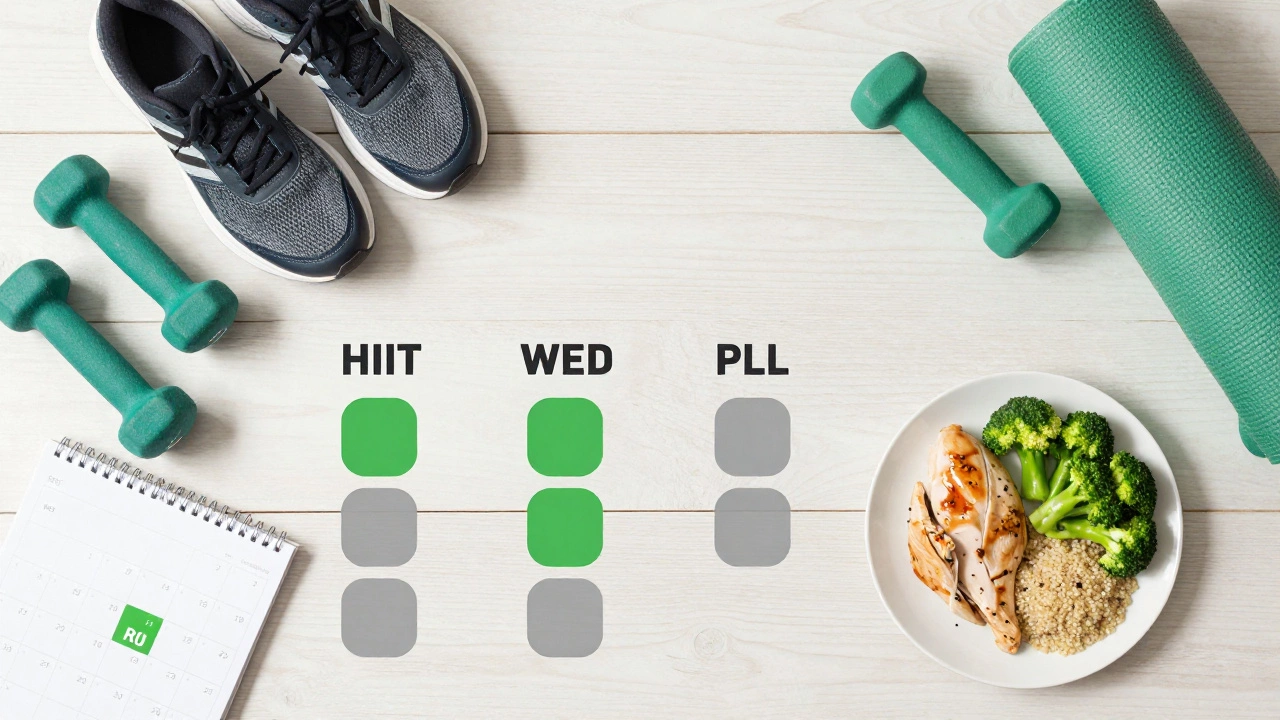
Consider pairing HIIT with strength training. Lifting weights builds muscle, and muscle tissue burns more calories at rest than fat tissue does. A balanced weekly schedule might look like this:
| Day | Activity | Duration | Focus |
|---|---|---|---|
| Monday | HIIT Cardio | 20 mins | Fat burn & endurance |
| Tuesday | Strength Training | 45 mins | Muscle building |
| Wednesday | Active Recovery | 30 mins | Yoga or walking |
| Thursday | HIIT Cardio | 20 mins | Fat burn & endurance |
| Friday | Strength Training | 45 mins | Muscle building |
| Saturday | Low-Intensity Steady State (LISS) | 45 mins | Cardiovascular health |
| Sunday | Rest | 0 mins | Recovery |
This approach ensures you’re challenging your body in different ways, preventing plateaus and reducing injury risk. LISS activities, like brisk walking or cycling at a conversational pace, are excellent for burning calories without adding stress to your CNS.
Signs You Are Doing Too Much
Your body will tell you if you’re pushing it too hard. Listen closely. If you experience any of the following, cut back on HIIT frequency or reduce the intensity:
- Persistent soreness: Muscle soreness that lasts more than 72 hours indicates insufficient recovery.
- Elevated resting heart rate: Check your pulse first thing in the morning. If it’s consistently higher than usual, your body is under stress.
- Decreased performance: If you’re getting slower or weaker instead of faster and stronger, you’re overtrained.
- Mood changes: Irritability, anxiety, or lack of motivation are common signs of CNS fatigue.
- Sleep disturbances: Trouble falling asleep or staying asleep despite being physically tired.
When these signs appear, swap HIIT for gentle movement like swimming, hiking, or yoga. Give your joints and nervous system a break. Weight loss is a marathon, not a sprint, and consistency over years matters far more than intensity over weeks.
Common Mistakes to Avoid
Many people sabotage their HIIT efforts by making simple errors. Avoid these pitfalls to stay on track:
- Skipping the warm-up: Jumping straight into burpees increases injury risk significantly.
- Focusing only on speed: Form comes first. Poor technique during high-intensity moves can lead to serious injuries, especially in the knees and lower back.
- Ignoring nutrition: You can’t out-train a bad diet. Ensure you’re eating enough protein to support muscle repair and complex carbohydrates for energy.
- Comparing yourself to others: HIIT is personal. Your "high intensity" might be someone else’s "moderate." Focus on your own heart rate and perceived exertion.
- Doing it every day: As mentioned, rest is when the magic happens. Trust the process and take those rest days.
Remember, the goal isn’t to suffer through every workout. It’s to build a sustainable lifestyle that supports your health and weight loss goals. By sticking to 3-4 sessions of 15-30 minutes per week, you’ll see steady progress without burning out.
Can I do HIIT every day to lose weight faster?
No, doing HIIT every day is generally not recommended. HIIT places significant stress on your central nervous system and muscles. Without adequate rest days, you risk overtraining, injury, and elevated cortisol levels, which can actually hinder fat loss. Aim for 3-4 sessions per week instead.
How long should a HIIT session last for beginners?
For beginners, a HIIT session should last about 15-20 minutes, including warm-up and cool-down. The actual high-intensity work portion should be no more than 10 minutes. Start with longer rest periods (e.g., 1:2 work-to-rest ratio) and gradually increase intensity as your fitness improves.
Is HIIT better than steady-state cardio for weight loss?
HIIT is more time-efficient and can create a greater afterburn effect (EPOC), meaning you burn more calories post-workout. However, steady-state cardio (like walking or jogging) is easier to recover from and can be done more frequently. Both are effective; combining them often yields the best results for weight loss and overall health.
What is the best time of day to do HIIT?
The best time is whenever you can consistently fit it into your schedule. Some studies suggest morning workouts may boost metabolism throughout the day, but consistency matters more than timing. Just ensure you eat adequately before and after your session to fuel performance and recovery.
How quickly will I see weight loss results with HIIT?
Results vary based on diet, starting fitness level, and consistency. Most people notice initial improvements in energy and endurance within 2-4 weeks. Visible fat loss typically takes 4-8 weeks of consistent HIIT combined with a caloric deficit. Remember, weight loss is not linear, so focus on trends rather than daily fluctuations.