The Downside of Fitness Trackers: Why You Might Want to Ditch the Wristband
Body Intuition vs. Data Checker
How do you feel right now? Instead of checking your wristband, select the physical sensation that best describes your current state to see how to interpret it intuitively.
Energy Level
Feeling wired, sluggish, or balanced?
Morning Wake-up
How did you feel before checking the app?
Workout Feel
Are you pushing through or flowing?
Select a Category
Click one of the cards above to start your body scan.
Before you decide to toss your device into a drawer, it is worth looking at how these tools change our relationship with movement and health. We are trading intuitive bodily signals for digital approximations. When we stop asking 'How do I feel?' and start asking 'What does the app say?', we lose a critical piece of the human experience: interoception, or the ability to sense the internal state of the body.
The Accuracy Gap and the Anxiety Loop
Let's be real: your wristband isn't a medical-grade device. Fitness trackers are wearable electronic devices that monitor and track fitness-related metrics such as steps, heart rate, and sleep patterns. They use sensors like accelerometers and optical heart rate monitors, but they are prone to error. For instance, a tracker might mistake a bumpy car ride for a brisk walk or misinterpret a high resting heart rate due to caffeine as a sign of overtraining.
The problem isn't just the occasional wrong number; it's the psychological weight we give those numbers. When a device tells you that your Heart Rate Variability (HRV)-a measure of the variation in time between each heartbeat-is low, you might feel forced to take a rest day. But what if you actually feel energetic and strong? By following the data blindly, you ignore your own physical intuition, potentially missing out on a great workout or creating unnecessary anxiety over a metric that varies naturally based on hydration or room temperature.
The Gamification of Health and the Reward Trap
We've all been there: you're lying in bed at 11:30 PM, and you realize you're only 200 steps away from hitting your daily goal. You get up and pace around the living room just to make the circle close. At that moment, you aren't exercising for health; you're playing a game. This shift from intrinsic motivation (doing something because it feels good) to extrinsic motivation (doing it for a digital badge) can actually kill your long-term passion for fitness.
When the reward is a gold star on a screen, the actual activity becomes a chore. If the battery dies or you forget to wear the device, you might find yourself thinking, "If it's not tracked, it didn't happen." This mindset strips the joy out of a spontaneous hike or a casual swim. You stop moving for the sake of movement and start moving for the sake of the Algorithm, which is a dangerous path toward burnout and resentment toward exercise.
The Sleep Tracking Obsession
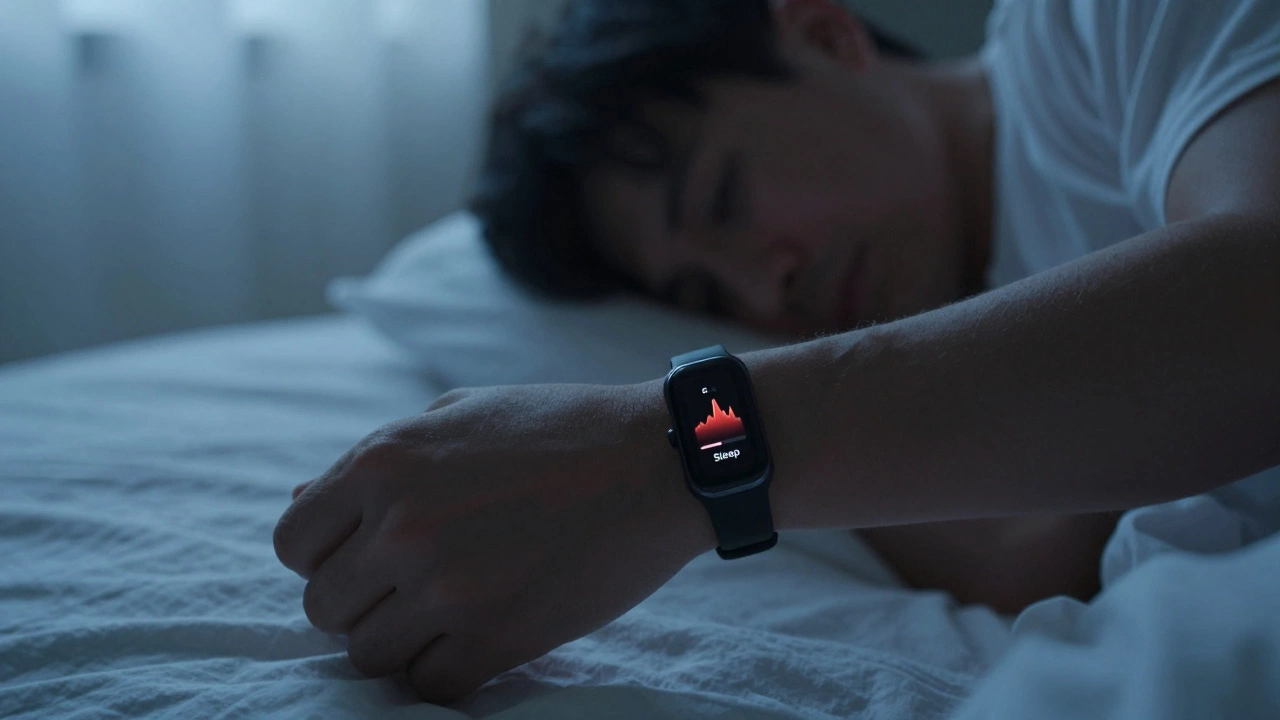
One of the most common pitfalls is the obsession with sleep scores. Sleep Tracking is the process of using wearable tech to monitor sleep stages, such as REM and deep sleep. While the idea of optimizing rest is appealing, it often leads to a condition known as orthosomnia-a preoccupation with achieving 'perfect' sleep data that actually causes insomnia.
Imagine waking up feeling great, but then checking your app and seeing that you only got 40 minutes of deep sleep. Suddenly, you feel tired. You've essentially talked yourself into a state of fatigue based on a sensor that can't actually see your brain waves. Unlike a polysomnography test in a clinic, a wrist-based tracker guesses your sleep stages based on movement and heart rate. It is an educated guess, not a clinical fact.
Data Overload and the Loss of Presence
We are living in an era of constant quantification. Between calories burned, active minutes, and blood oxygen levels, we are treating our bodies like machines to be optimized rather than living organisms to be nurtured. This constant monitoring creates a mental load that can outweigh the physical benefits. Instead of enjoying the flow of a run, you're constantly checking your pace and heart rate, breaking your mental connection with the environment.
| Feature | Intuitive Approach | Tracker-Led Approach |
|---|---|---|
| Decision Making | Based on felt energy and mood | Based on metrics and scores |
| Motivation | Internal satisfaction/joy | External badges/streaks |
| Focus | Mind-body connection | Numerical targets |
| Stress Level | Generally lower; flexible | Potential for 'data anxiety' |
Privacy and the Hidden Cost of Data
Beyond the mental toll, there is the issue of where your data goes. When you wear a device from a major tech company, you aren't just getting a health tool; you are providing a continuous stream of biometric data. Biometric Data includes biological measurements like heart rhythm and activity levels. While companies claim this data is encrypted, the reality is that your most intimate health patterns are stored on servers.
In some scenarios, this information could influence insurance premiums or be used for targeted advertising based on your stress levels or sleep quality. The trade-off for a convenient step counter is a permanent digital record of your physical existence. For those who value privacy, the risk of a data breach or the sale of health insights to third parties is a significant reason to avoid these devices entirely.

Reconnecting With Your Body
So, what happens if you stop wearing a tracker? At first, it feels weird. You might feel like you're 'losing' progress. But after a few weeks, something interesting happens. You start to notice the subtle signs of your body again. You realize you're tired not because an app told you so, but because your shoulders feel heavy and your focus is slipping. You realize you've had a great workout not because you burned 600 calories, but because you feel an endorphin rush and a sense of accomplishment.
Switching to a more intuitive style of health management means listening to the Autonomic Nervous System, which regulates involuntary physiological processes. When you stop relying on a screen, you force yourself to engage with your own biology. You learn the difference between 'good' soreness from a workout and 'bad' pain from an injury, rather than trusting a recovery score to tell you when it's safe to train again.
Finding a Middle Ground
If you aren't ready to go completely 'analog,' you can change how you use your tech. Instead of wearing it 24/7, use it as a periodic tool. Wear it for one week a month to get a general sense of your trends, then take it off. Use it for specific goals, like training for a marathon, but remove it during your leisure time.
The goal is to move from being a slave to the data to using data as a supporting character. Your health is not a series of numbers on a dashboard; it is the quality of your breath, the strength of your muscles, and the clarity of your mind. None of those things can be fully captured by a green LED light on the back of a watch.
Do fitness trackers actually provide accurate data?
They provide estimates, not exact measurements. While heart rate tracking during steady exercise is generally decent, calorie burn estimates can be off by 20% to 40% because they don't account for individual metabolism, muscle mass, or efficiency. Sleep stage tracking is even less accurate, as it relies on movement and heart rate rather than brain activity (EEG).
Can a fitness tracker cause anxiety?
Yes, through a phenomenon called 'data anxiety.' When users become overly dependent on metrics like sleep scores or HRV, they may experience stress if the numbers are low, even if they feel physically fine. This can create a feedback loop where the anxiety about the data actually worsens the health metric being tracked.
Will I lose motivation if I stop tracking my steps?
Initially, you might feel a lack of direction. However, this is often a sign that your motivation was extrinsic (driven by the app) rather than intrinsic (driven by the enjoyment of movement). Transitioning to a goal based on how you feel or the distance you travel rather than a step count can lead to more sustainable, long-term habits.
Is it better to use a chest strap or a wrist-based tracker?
For accuracy, chest straps are far superior. They measure the electrical activity of the heart (EKG) rather than using light to estimate blood flow (PPG). If you need precise data for athletic training, a chest strap is the way to go, as it avoids the 'noise' and movement interference common with wrist-based sensors.
How do I start listening to my body instead of an app?
Start with a 'body scan' every morning. Before checking your phone, ask yourself: How is my energy? Where do I feel tension? How was my mood upon waking? During workouts, use the 'talk test'-if you can't speak a sentence, you're at high intensity. This shifts your focus back to internal sensations rather than external numbers.